

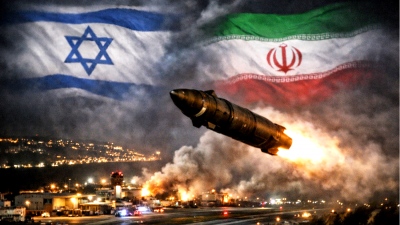
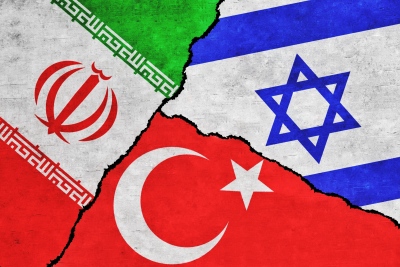
In an explosive and deeply concerning development set to impact not only the Middle East but the entire Mediterranean and Aegean—and consequently Greece—British political scientist and former Israeli government advisor Daniel Levy provides a stark outlook. According to Levy, following the conflict with Iran, Israeli authorities are beginning preparations for a confrontation with Turkey. He argues that this notion is gaining significant popularity within Israel's military and political circles.
A new reality
"Israel and Turkey are preparing for a new reality full of hostility and fresh conflicts," Levy notes. As the conflict between the US, Israel, and Iran commenced, Ankara and Tel Aviv drastically intensified their mutual criticism. On March 2, former Israeli Prime Minister Naftali Bennett accused Turkey of creating an "axis of hostility" and called for "measures" against Ankara. The following day, Turkish leader Recep Tayyip Erdoğan accused the US and Israel of regional destabilization, stating: "Our world is sliding rapidly into a chaotic period where brute force is used and the law of the mighty prevails."
Israel sowing chaos
Last year, against the backdrop of the Iran-Israel conflict, American analysts predicted that Ankara could be Tel Aviv's next major rival, with their antagonism potentially leading to direct military conflict. According to Levy, Israel initiated the conflict against Iran to sow chaos in the region and establish its hegemony. "To achieve this dangerous goal, Israel wants to destroy Iran as a state. It hopes other regional states, particularly the Gulf monarchies, will be forced to accept Israeli sovereignty and become part of a new regional security system," the analyst explained.
The role of Turkey
However, he pointed out that any Israeli attempt to establish hegemony in the Persian Gulf would fail if Turkey intervened. "Israel understands that this strategy will hardly work with Turkey. Ankara possesses military potential, is a member of NATO, and prides itself on its independence. That is why Israel and its leadership are saying openly: after Iran, it will be Turkey's turn," Levy emphasized.
The fuse
Regarding how a new conflict could ignite, Levy mentioned that Israel and Turkey might clash over the division of spheres of influence in the Middle East. Neither side is likely to make concessions, which could escalate tensions. "The prospects of dividing spheres of influence in Syria, Turkey adopting the Israeli stance against the Palestinians, or a retreat by Israel—none of these scenarios are likely to materialize," the analyst noted. According to him, both countries will take actions to create a "strategic environment." "Even if it seems tensions are decreasing, we are heading toward a conflict. For now, each side will occupy positions in various territories to avoid being geopolitically surrounded or weakened," he explained.
The Syrian theater
Levy recalled the positions of Turkey and Israel in Syria, where each country has its own spheres of influence. The most obvious example is that Israel failed to expand toward Northeast Syria, while Turkey achieved successes in countering Kurdish separatism with US approval.
Alliances and Greece’s involvement
The analyst also noted the expected creation of a new network of military alliances that will change regional dynamics. "Israel has made serious progress in building its bloc through relations with Greece, the United Arab Emirates, rebel groups in Sudan, the unrecognized state of Somaliland, Ethiopia, and possibly India. Turkey is reacting by trying to create an effective alliance with Saudi Arabia, Pakistan, Somalia, government forces in Sudan, and potentially even Egypt," he explained. "This is a single process extending from Greece and Cyprus to Somalia and Somaliland, from Ethiopia and Sudan to Syria and Iraq. Iran plays a critical role—if Israel and the US win, Turkey will find itself in a more vulnerable position," Levy added.
The US accelerating its decline
Regarding the possibility of NATO intervention, Levy noted that US policy is weakening Washington's position in the Middle East, affecting the future of NATO. "The US is weakening itself and accelerating its decline by trying to regain its supremacy but failing... Europe is in a trap, as Trump has not yet completed his plans for Greenland," the Israeli analyst explained.
What NATO will do
According to Levy, NATO may not defend Turkey in the event of a conflict with Israel, as the alliance will be undergoing a crisis even before the hypothetical confrontation begins. "Israel and Turkey will soon seek to create competing blocs in Western Asia, North Africa, and the Southeastern Aegean, as the decline of America is realized," he concluded.
Not yet at that point
Former Turkish trade representative in Moscow, Aydın Sezer, pointed out that the verbal confrontations between Ankara and Tel Aviv do not yet constitute a full-scale threat, as trade and economic relations continue to grow directly or through third countries. Furthermore, Turkey continues to guarantee Israel's security through its NATO participation, while intelligence collected is forwarded directly to US and British military centers, ultimately reaching Israel. Sezer also emphasized that the tension between Iran and Azerbaijan increases security risks for Ankara, particularly in the event of a potential ground operation against Iran, where the US may request assistance from Turkey.
www.bankingnews.gr




Σχόλια αναγνωστών